
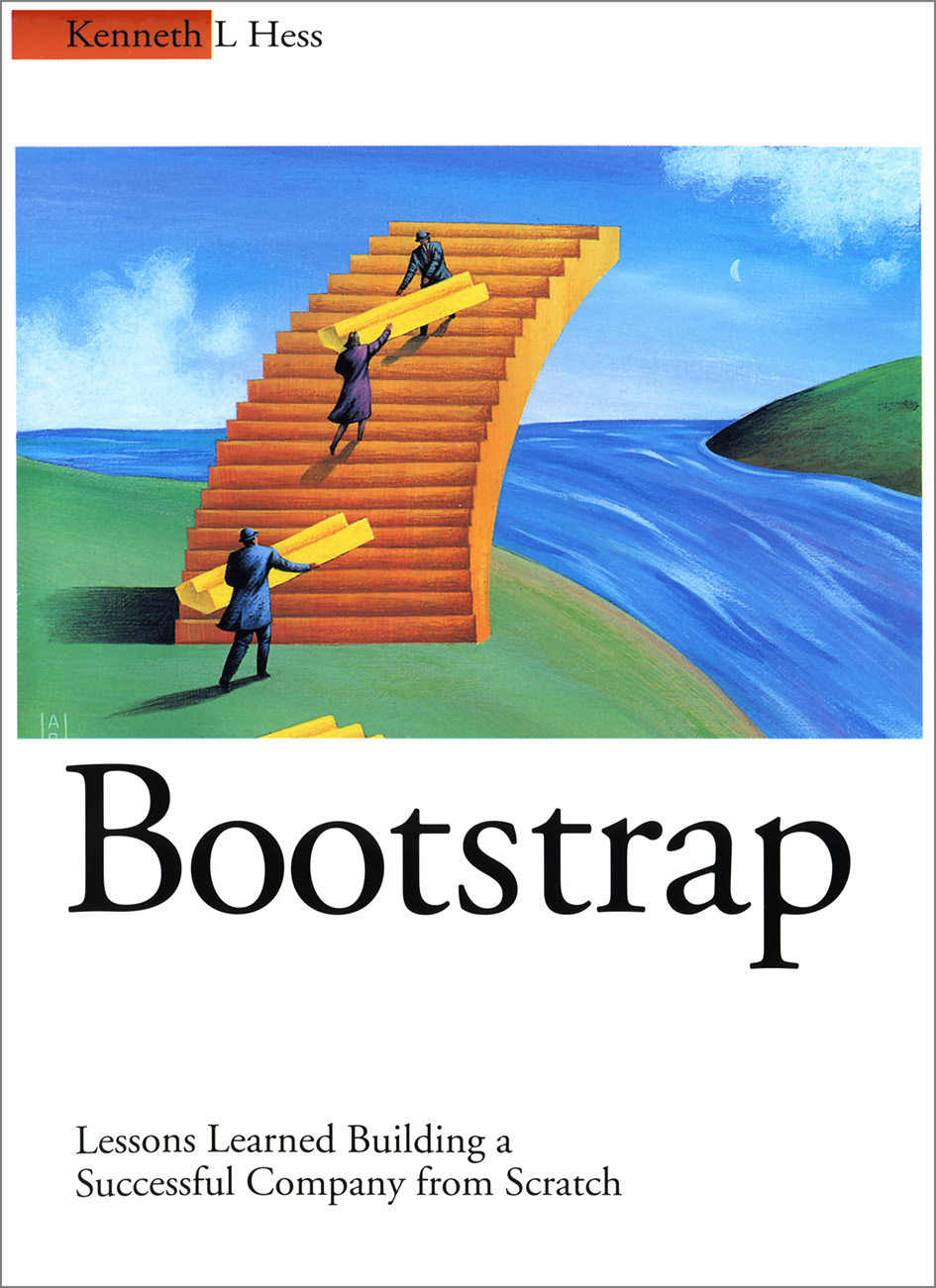
Hardcover 303 pages (October 2001)
S-Curve Press; ISBN: 0-9711873-0-4
US $24.95, Kindle Version US $3.99
Order or “Look Inside” at Amazon
Advance Praise for Bootstrap
“An excellent reference for anyone wondering what it takes to be an entrepreneur.”
— John Glynn, Professor of Entrepreneurship, Stanford Graduate School of Business
“More than a how-to book, it is one of an entrepreneur’s journey, accurately detailing both the personal and professional struggles that he must overcome on the way to the top, and what he will face once he arrives.”
— John Neer, Executive, Lockheed Martin and former Founder, Space Imaging
“Solid advice on every step of building a company, from developing a product to selling the company.”
— Heidi Roizen, Managing Director, SOFTBANK Venture Capital
“Not your typical Silicon Valley venture capital story. This book shows bootstrapping is a viable way to start and win at building a high tech company.”
— Chuck McMinn, Founder and Chairman, Covad
“Brilliantly written and well organized, it serves as an invaluable source of usable thoughts, tools, and philosophies on building a company.”
— Monty Allen, CFO Globenet
What’s It Like?
What’s it like to start a business from scratch? I found it to be intensely creative and stimulating — so rewarding that I’ve done it more than once. Yet the very thought of leaving a job to start your own business scares many people. Should you start your own company?
. . . . . . . . . . . . . .
My book Bootstrap provides an honest, insider’s window into the process I went through, starting with a dream and ending years later with the sale of my company, Banner Blue Software, at a handsome price.
I certainly had many questions before I founded Banner Blue and I’m sure you do as well:
- How do I find a good product idea? Or, is the idea I have good enough?
- How do I obtain the money to start a company?
- Can I live on a reduced income until my company gets on its feet?
- Can I run a successful business, raise children, and still have a normal family life?
- What personal qualities does it take to found a successful business and do I have them?
- What education and experience is the best preparation for becoming an entrepreneur?
- What if I fail?
As I built my business I learned answers to these questions and many others. Ultimately, I did more things right than wrong, for Banner Blue Software went on to great success. I hope that by sharing what I learned, you can improve your chance of success and minimize your mistakes.
During my tenure at Banner Blue, there were many twists and turns as the business and technology environment changed. I actually founded Banner Blue to produce a piece of business software called Org Plus — a product that became quite successful in its own right. And, before I left the company, I designed and managed Family Tree Maker Online, one of the most popular Web sites of its time, receiving over 75,000 unique visitors per day (that was a very big number at the time!).
Of course, some of my product ideas were expensive failures — I hope we can both learn from those experiences.
Ken’s Years at Banner Blue Software
From 1984 to 1996, Ken was Founder and President of Banner Blue Software in Fremont, California. Ken bootstrapped this software development company from a personal investment of $20,000 and no outside funds, guiding it to annual sales of $23 million and acquisition by Broderbund Software, Inc. In so doing, he navigated platform transitions from DOS to Windows to CD to Internet and distribution transitions from direct mail to software reseller to consumer mass merchandiser — with sales growth and outstanding profits every single year.
In 1994, Banner Blue acquired Automated Archives, Inc., a genealogy data compiler, from internally generated cash flow. Through 1996, Banner Blue sold approximately two million copies of software through direct and retail channels, primarily Family Tree Maker® (for locating and organizing information about one’s ancestors) and Org Plus® (for making corporate organization charts).
Ken personally wrote the initial versions of both these award-winning programs. Ken’s engineering work also received one of the first software patents, Patent 4,764,867, Display System and Method for Constructing and Editing a Hierarchical Arrangement of Information, issued August 1988 by the USPTO.
Family Tree Maker and Org Plus have appeared on numerous industry hot sales lists and won numerous awards for quality. During the first half of 1996, Family Tree Maker was one of the top three selling personal productivity product lines according to PC Data. An OEM version of Org Plus was shipped as a component of Microsoft’s PowerPoint for almost a decade, accounting for additional sales of many tens of a million units. As of 2020, modern versions of Family Tree Maker and Org Plus are still available.